
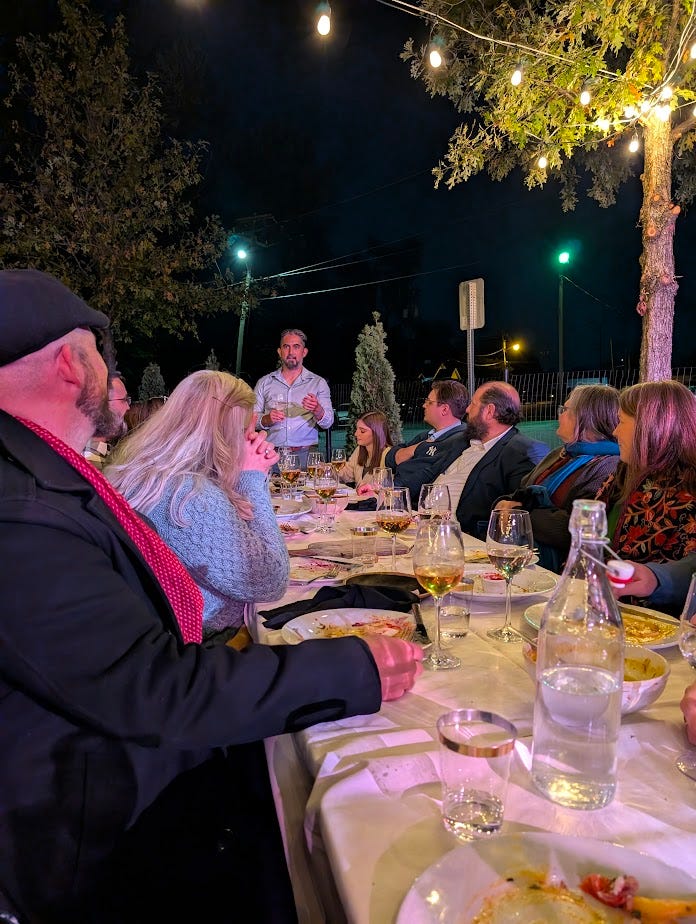
Earlier this month, I attended an event called Southeastuary, where I learned lessons on passing down traditions, ruminated on the dangers of AI to human interaction and progress, and connected face-to-face with many people I’ve interacted with previously online.
Last weekend, I attended the Art of the Tamada, an event hosted by the First Things Foundation at Keipi, a nonprofit restaurant in Greenville, South Carolina. The event aimed to impress on the attendees the importance of eating with strangers, learning their stories, and organizing dinners like this on their own.
What is a Supra and How Can it Change the World
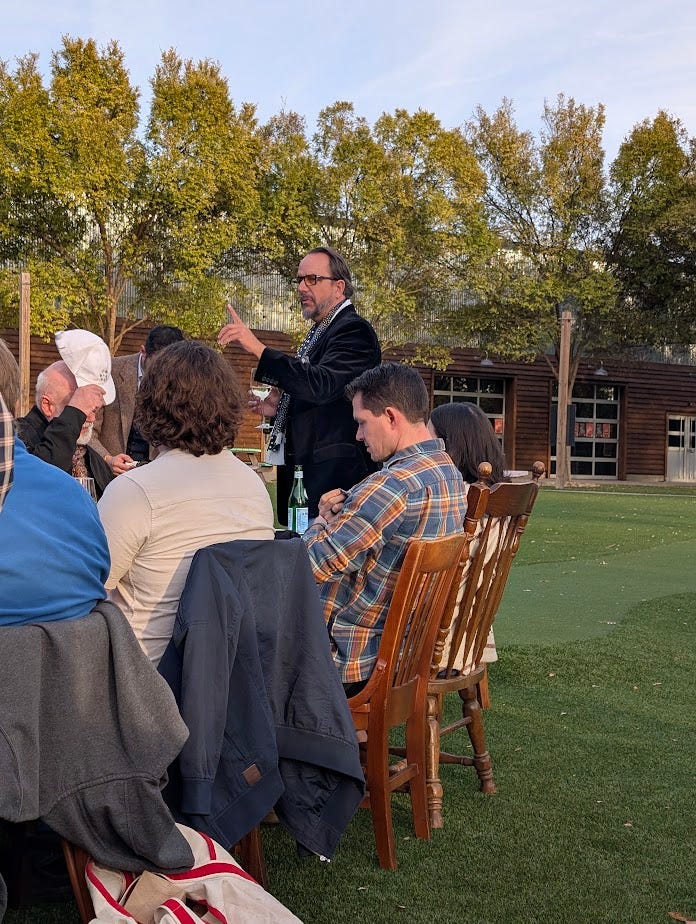
At the Art of the Tamada, they had three tables setup to host a proper Georgian supra. The Supra is a Georgian tradition where a tamada (toastmaster) leads a table in a series of toasts where diners are invited to share from their personal lives. The supra is intended to be a fully participational event where everyone gets to learn about everyone and at the Art of the Tamada that reality was certainly borne out.
Each table (there were three total) had around 18 guests, with one tamada each who performed a series of toasts that were performed as an act of poetry and an invitation to participation.
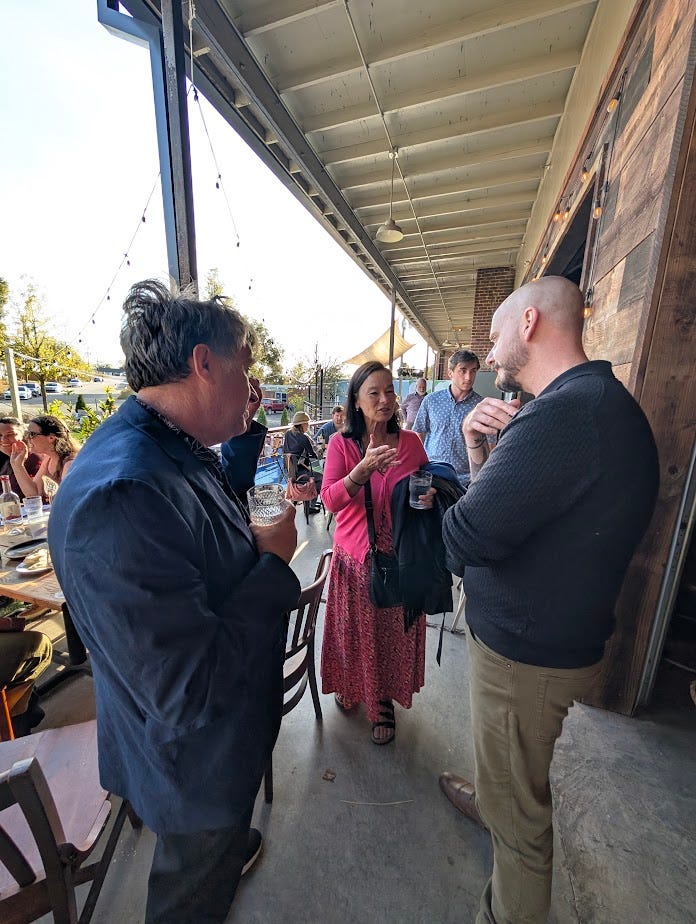
Our table was particularly lively with a great mix of characters who, over the course of the evening, truly went from strangers to something approximating family. I could do a long article on how great the food was, the history of the tradition, and talk about how Heers feels very deeply on the fact that the supra can help to bridge the deepening divide in our increasingly polarized world.
But that story isn’t truly mine to tell or something that I specialize in. Instead, I want to focus on something that came to mind in between sips of amber wine and yelling, “GAGIMARJOS” as loud as I could because our tables were at war to be the best.
How Food & Restaurants Create Place
(The above video was the morning of the event. I took Tony to a semi-legendary Greenville establishment, Swamp Rabbit Grocery, and we found a piano that said play me)
There is a certain issue we have with how we eat food, and the success of restaurants like Keipi (which hosts a weekly community supra on Friday nights) only seems to prove that. “Experiential dining” seems to be popular in many cities, where you can go out to eat in a group setting, usually with non-American food.
There are plenty of diverging opinions on how we eat (eating out vs cooking at home), what we eat (healthy food vs fast food), and how much we consume (overeating vs eating disorders), but much of our “displacement” can be traced to the food truckification of the country.
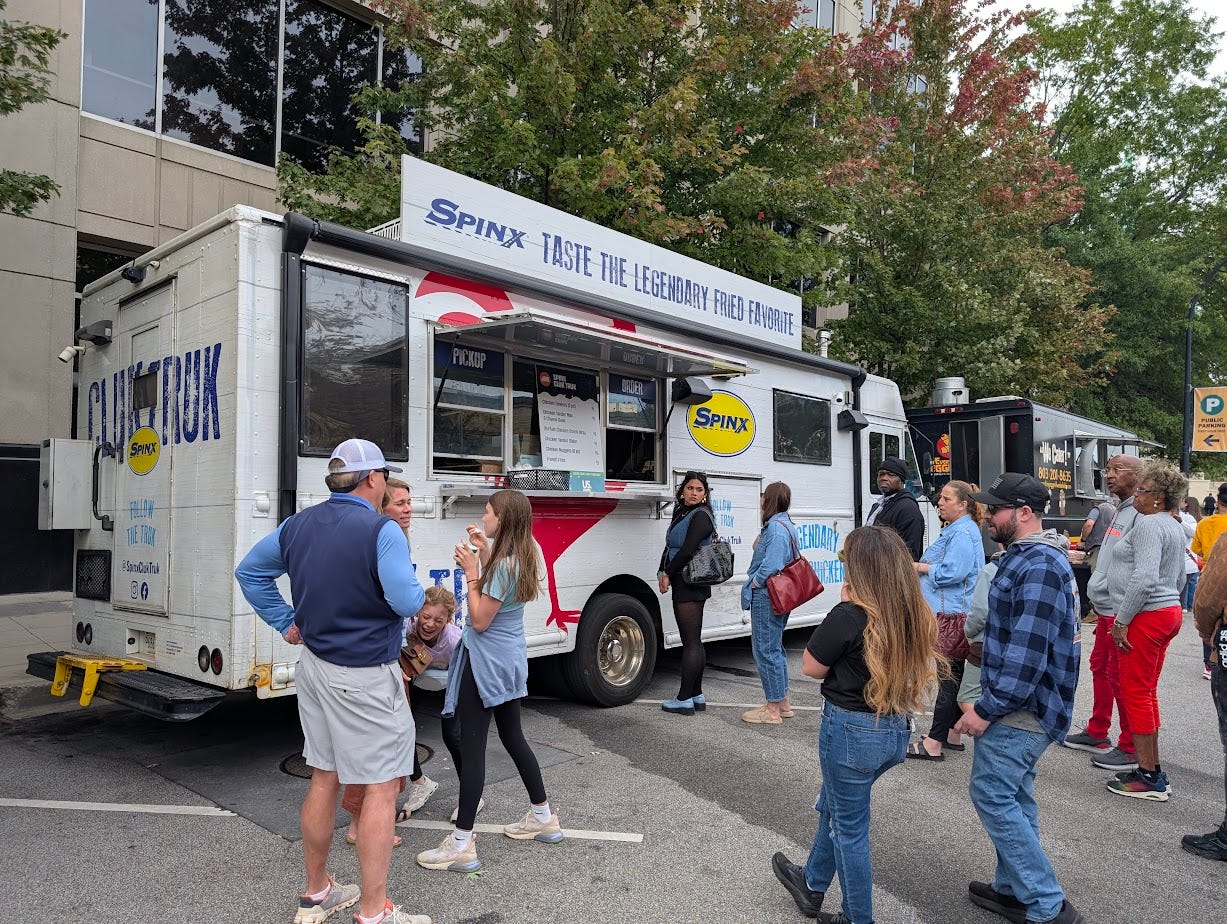
For the record, I am not a food truck hater or a brick-and-mortar purist. Food carts can play an important role in “creating place,” and food trucks have a similar role, but the problem with food trucks is the role they've played in changing how we view the food we eat.
Food trucks require food to either be made quickly onsite or slowly ahead of time and merely reheated. Food trucks are great for prospective restaurateurs because they can be brought to people (as opposed to people having to come to them) and can take advantage of car-centric urban design at places like office parks and festivals.
For the busy person on the go, the food truck (along with the drive-thru) allows ultimate convenience and the avoidance of most conversation. The food truck model offers a limited menu, simple food that can be eaten quickly, and ideally something that provides a taste of a different culture (to add some spice to the otherwise blandness of the experience).
With the rise of the food truck, restaurants were forced to adapt. One of the biggest adaptations has been the rise of the “slop bowl counter.” Restaurants like Chipotle, Cava, and Sweetgreen offer a curated experience of a specific ethnic cuisine, but served in bowl fashion, which is quickly being called a “slop bowl.”
The success of these companies has created more and more copycats, which has only further destroyed the fabric of our historic restaurant culture. The restaurant has generally been an extension of hospitality and the culmination of a family’s vision.
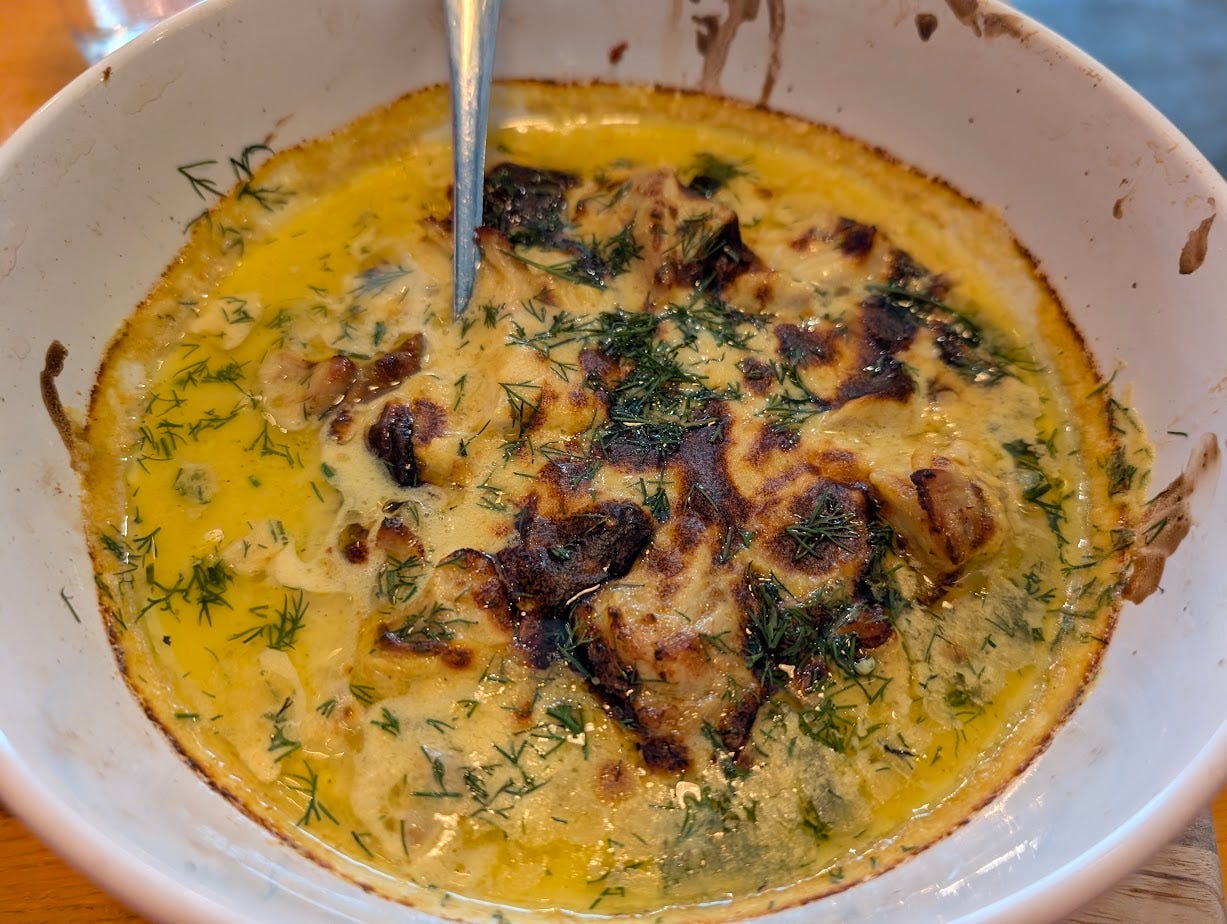
The restaurant that serves slop, whether mobile or stationary, promotes a culture increasingly disconnected from the world we live in. Dishes - whether from nobility or peasantry - pass down a tradition that is embedded in a set of ingredients and the order in which they are fused.
Food was created to be something special. Something shared. There is great artistry even in the simplest street foods, whether tacos, gyros, or hot dogs, because they reflect a tradition passed down. When our food is but a mere parody of the culture it comes from, very little can be shared, learned, or enjoyed in the long run.
Experiences like the supra are as important in rebuilding the trust and culture that has been lost from our world as the recipes and culture being lost in the slop of the machine that is being churned out every day.
So this is intriguing. Industrially slop has long been a norm (Dickinsonian porridge and prison slop, perhaps even to some degree school lunch, at least the old stereotype). Hugely scalable, cheap, little skill.
But restaurant and restaurant culture is an outgrowth if I recall of 18th century France. Where we see a shift of private chefs for the wealthy start to cater to anyone who could pay, this includes having a menu with choices, and a designated seating area. Before that we have lots and lots of forms of dining-
Taverns with no choices (eat what you get for whatever they charge), cafes/bars which mostly had drinks and snacks, and food stalls where you either just purchased and walked away or had something like a food counter.
Food trucks are very similar to the old medieval food stalls In this sense.
Communal festive meals being tied to restaurants seem a form of commodification and modernity to me (though maybe this is really how Georgian restaurants work?)
Just in its own way
Excellent as always. The last point about food is one which dovetails into the issue of our world of plenty as contrasted to the world of privation.
Our traditions around food largely dwindle because food cultures were built around hard limits. You have somethings which you can cook with, and others which you cannot because you do not have them.
In the age of abundance that constraint is gone, and so the menu becomes enlarged, but at the same time the traditions attached to the old menu fade (with notable exceptions like Turkey on Thanksgiving).